














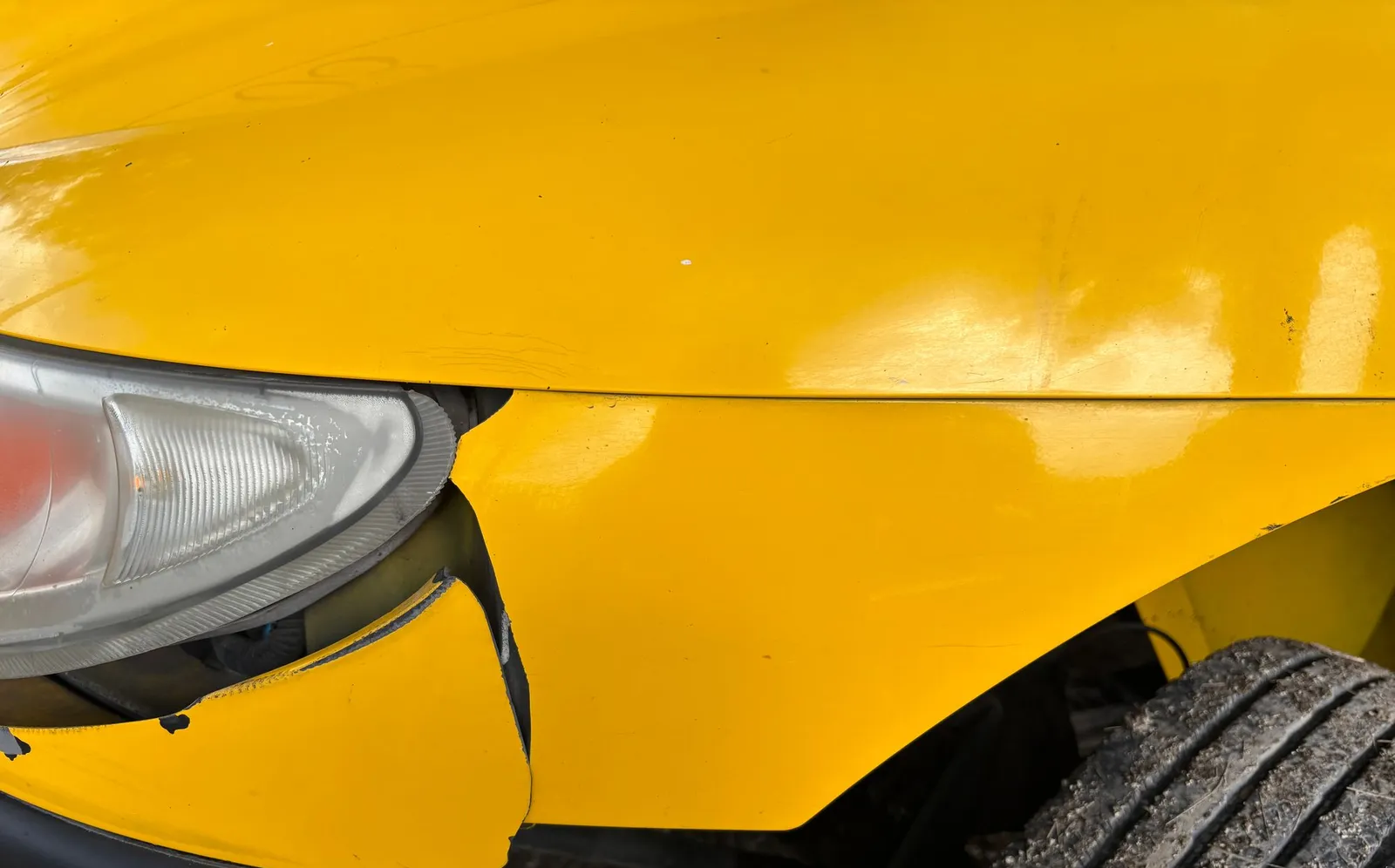
If somebody rear-ends your ten-year-old sedan, the likeliest outcome is not a repair. It’s a check, and the check is probably smaller than you think.
The share of auto claims flagged as a total loss reached 23.1% across all loss categories in 2025, a record, according to CCC Intelligent Solutions’ Crash Course 2026 report. Strip out theft and weather claims and it’s 23.9%. On vehicles 13 years and older, total loss frequency runs 45.3%. Nearly a coin flip.
Here’s what they don’t tell you at the scene. Your insurer is not weighing whether your car deserves to be saved. It’s running arithmetic. Once the repair estimate crosses a percentage of your car’s pre-accident value, the vehicle is a total loss, and in many states that percentage is written into the code rather than chosen by an adjuster. You don’t get a vote on the number.
Two things are pushing more cars over the line. Repairs got expensive: CCC puts the average total cost of repair at $5,721 on vehicles six years or newer against $3,682 on cars seven and older, and 28.3% of repairable estimates now include a sensor calibration, at an average of about $486 a pop. Meanwhile the fleet keeps aging, with 12 million fewer vehicles six years old or newer on the road than in 2020. Rising repair bills on falling car values is exactly the recipe for a totaled car.
And the payout side moved the wrong way. CCC found total loss valuations fell 2.9%. Higher odds your car gets written off, slightly smaller check when it does.
That’s your money. If you rolled negative equity into the loan, your settlement is actual cash value and the gap between the check and your balance is yours to cover, in cash, on a car you no longer have.
So do three things, and do them before you ever file a claim.
Look up your state’s total loss threshold. It’s usually a single line in the insurance code and it tells you, roughly, how much damage your car can absorb before it’s gone. Rhode Island raised its threshold from 80% to 85% of pre-accident value effective June 26, 2026, and it’s the state that goes furthest in giving owners an explicit right to demand repair. Most states give you nothing like that, which is exactly why you should know where you stand.
Second, don’t accept the first actual cash value number. The insurer’s valuation is a report, not a verdict. Pull three current local listings for the same year, trim, mileage and condition, and send them to the adjuster in writing. Comparable listings are the only argument that reliably moves an ACV offer.
Third, if you still disagree, read your policy’s appraisal clause. Most standard auto policies let each side name an appraiser and settle the difference through a neutral umpire. It’s slow and it’s unglamorous and almost nobody uses it, which is precisely why insurers do not expect you to.
Then check whether you carry gap coverage. Check today, while nothing has happened. Find your car’s real value first with our insurance estimator and compare coverage at our auto insurance hub.
File this away. You’ll want it the week you need it, and that’s the week you won’t be reading anything.
How Candid Yak makes money. Some of the products we write about pay us if you apply or sign up through our links. That never changes our verdict, our rankings, or the numbers in this article. We call a bad deal a bad deal whether it pays us or not. Some brands shown in our comparison tools are placeholder examples while we finalize partner agreements, and we label them as such.