














The Photovoltaic Effect
Solar panels work through a process called the photovoltaic (PV) effect, discovered by French physicist Edmond Becquerel in 1839. The term photovoltaic comes from the Greek word for light (photos) combined with volta, named after Alessandro Volta, the inventor of the electrical battery. The effect describes the ability of certain materials to generate an electrical current when light hits them.
Modern solar panels are made mostly of silicon, the same material used in computer chips. Silicon atoms are arranged in a crystalline structure that is highly sensitive to incoming photons, the particles that make up light. When a photon strikes a silicon atom with enough energy, it knocks an electron loose, creating a flow of electrons. That flow of electrons is direct current (DC) electricity.
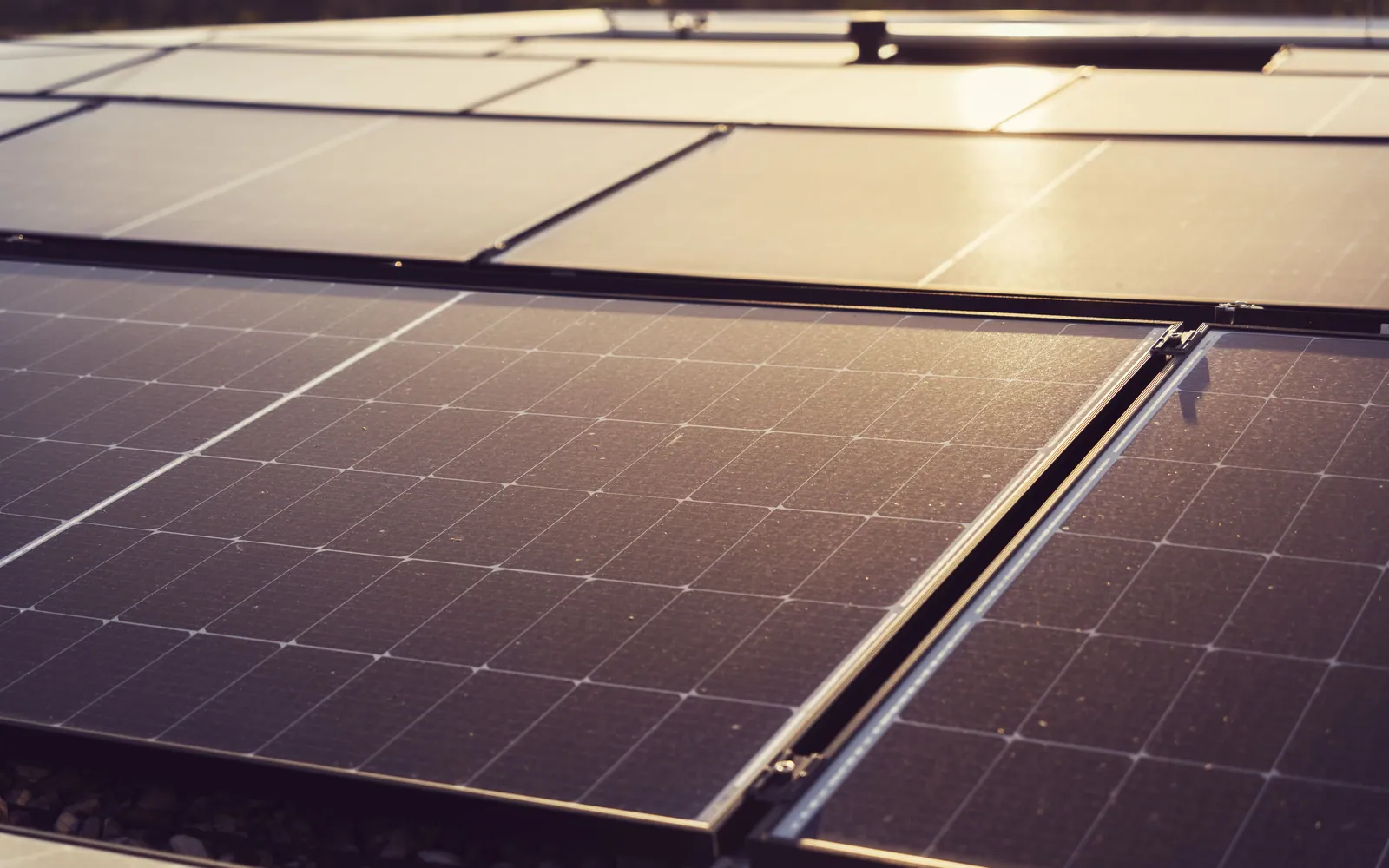
Each solar panel holds dozens of individual solar cells, each about the size of your palm. These cells are wired together within the panel, and multiple panels are wired together in a system to produce the total power output needed for a home or building.
From DC Power to AC Power: The Inverter
The electricity generated by solar panels is direct current (DC), but homes and the electrical grid run on alternating current (AC). An inverter turns the DC electricity from the panels into AC electricity your home’s appliances can use.
There are three main types of inverters. A string inverter is a single unit that handles the output from the entire array of panels. It is the simplest and least expensive option but has a weakness: if any single panel is shaded or underperforming, the whole string’s output drops to the lowest-performing panel.
Microinverters are small inverters attached to each panel individually, converting DC to AC at the panel level. That kills the shading problem. Each panel runs independently, so one shaded panel does not drag down the others. Microinverters (mostly made by Enphase) are the gold standard for homes with complex rooflines or partial shading.
Power optimizers, developed by SolarEdge, are a hybrid approach: DC optimizers at each panel maximize each panel’s output, and a central inverter converts the total optimized output to AC.
Net Metering: Selling Excess Power Back to the Grid
Most grid-tied solar systems connect to the local utility grid through a bidirectional meter. When your panels produce more electricity than you are using at a given moment, sunny midday when you are at work, for example, the excess power flows back to the grid.
Your utility credits you for that exported electricity at a rate set by your state and utility’s net metering policy. When your panels do not produce enough power (nighttime, cloudy periods), you draw from the grid using those credits. At the end of each billing period, you pay only for the net difference between what you used from the grid and what you sent to it.
Net metering policies vary widely by state and utility. Some states offer one-for-one credit (every kWh you send to the grid offsets one kWh you draw from it). Others pay less for exported power, which affects the economics of sizing your system.
Battery Storage and Going Off-Grid
Battery storage systems (most commonly Tesla Powerwall, Enphase IQ Battery, or SunPower SunVault) let you store excess solar production for use at night or during grid outages. They cut or kill your reliance on the grid and provide backup power during outages.
Going fully off-grid is technically possible with a large enough battery array but is rarely cost-effective compared with staying grid-connected with a modest battery system. Most residential solar customers use batteries as backup power and bill reduction tools rather than for full grid independence.
Solar panels do not power your home during a grid outage unless you have a battery storage system (or a generator). That surprises plenty of new solar owners. Without storage, the system automatically disconnects during outages to protect utility workers on the lines.